

Invasive Rats in Idaho
Invasive rats are a new and evolving issue facing the citizens of Idaho. The Idaho State Department of Agriculture (ISDA) is working to provide information and resources about rats, prevention, and possible treatment resources and strategies. In addition, is providing web-based mapping tools for property owners and private service providers to identify areas of infestation as well as treatment.
Risks and Impacts of Invasive Rats
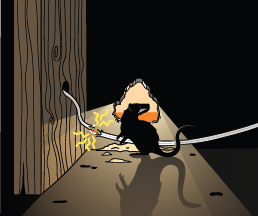
Rats are one of the most destructive invasive species in North America and can impact our day-to-day lives in various ways. Like all invasive species, rats reproduce unrestrained in an environment without natural controls in place. Rats can reproduce every 21-23 days with each period resulting in 12-18 new rats. Rats can heavily impact agricultural production by feeding on crops, foraging on small livestock like poultry, and contaminating feed or commodities. Infrastructure can also be impacted by weakening walls and chewing on electrical wires, resulting in increased fire risk and compromising stability. Rats are also host to more than 35 different diseases that can be transmitted to humans, including bubonic plague, typhus, and hantavirus.


Identify Invasive Rat Species
Use the factsheets below to help identify rat species of concern in Idaho. These resources highlight key physical traits, behaviors, and impacts of invasive Norway rats and roof rats, and how they differ from native packrats (woodrats).
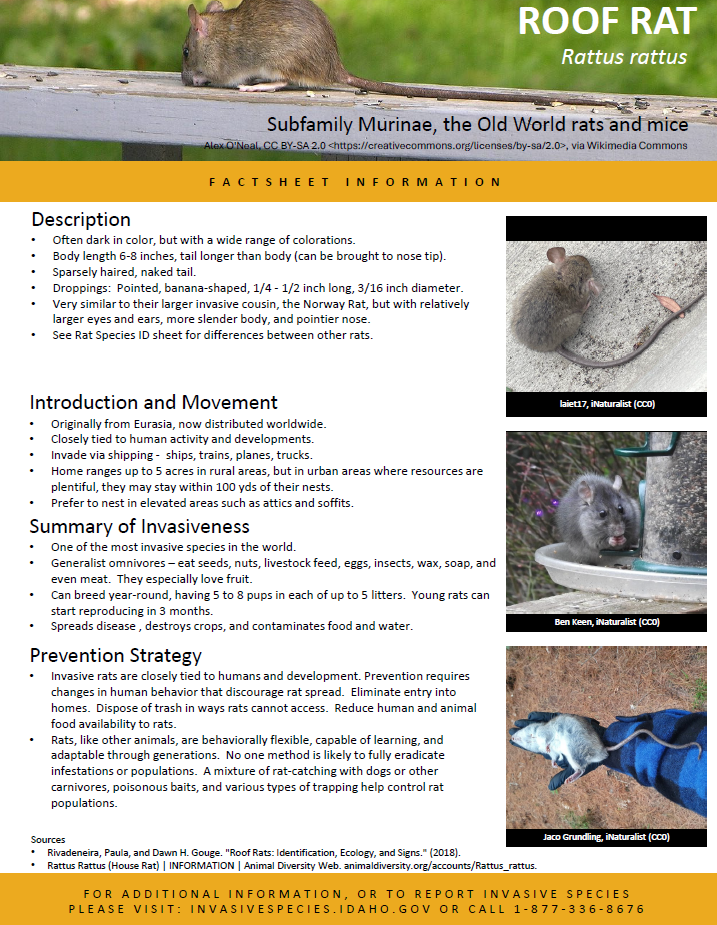
Roof Rat Information Sheet
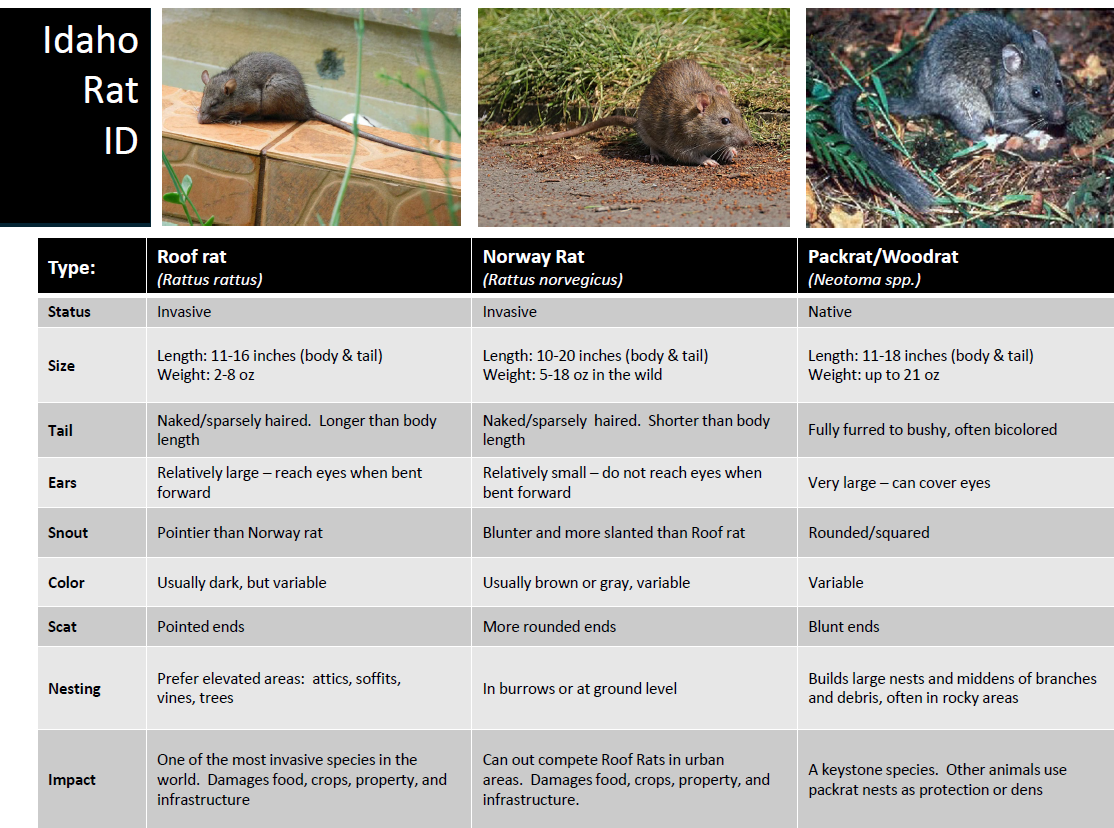
Rat Comparison Information Sheet
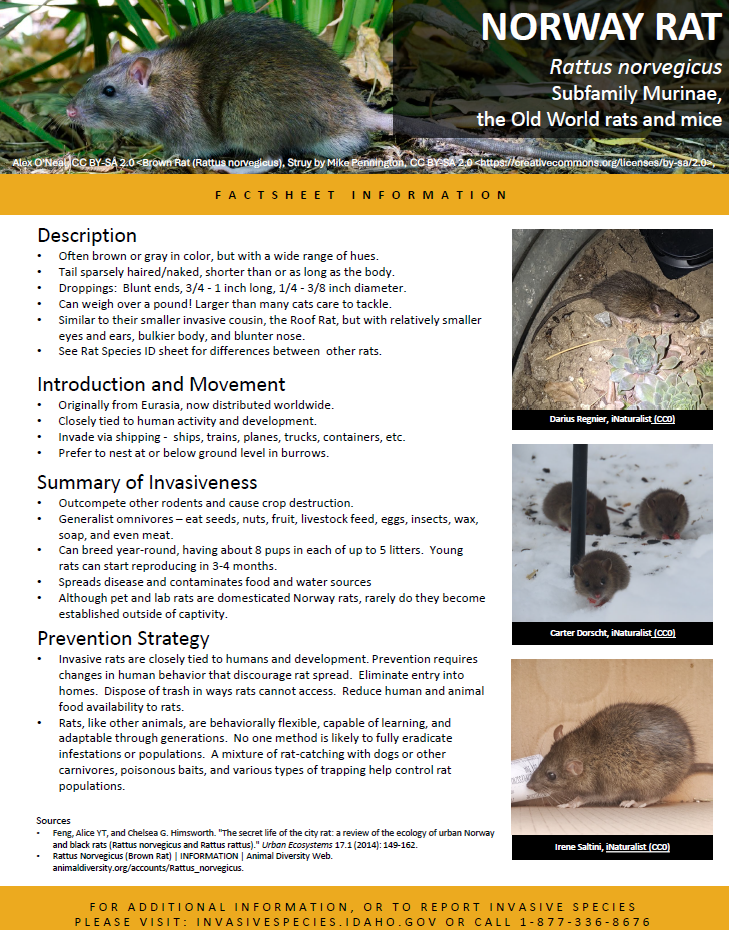
Norway Rat Information Sheet
Reported Invasive Rat Activity in Idaho
This heat map represents invasive rat reports presence and treatment collected through the user submitted survey below. Location data is intentionally generalized to protect privacy. Individual reports are summarized within neighborhood-level boundary blocks rather than shown at exact address locations. These boundaries may be expanded to the zip-code level when additional privacy protection is needed.

Invasive Rat Sighting Survey for the State of Idaho
Use this form to report rat sightings in Idaho.
Best management practices
As with many invasive species, prevention is the best control. Invasive rats are more likely to infest a home that has easy access to shelter, food, and water. Working to ensure that food is stored in sealed containers, standing water is controlled, garbage and compost is cleared up, and sealing entrances into houses and outbuildings will help discourage establishment.
Overall, a combined effort of exclusion, sanitation, and trapping are going to work best for preventing and controlling infestations.